NPPF 2026: what it means for local authorities

If you’re reading this, you may already be vaguely aware of the industry campaign that we backed, along with over 60 local authorities, businesses and NGOs. “The floor should never be the ceiling” summed it up. We strongly called for changes to PM13 (the section on setting standards) as it was originally drafted – arguing that it posed risks to local plan-making, net-zero delivery, energy affordability, health outcomes and local democratic decision-making.
So, how did the final National Planning Policy Framework turn out? TLDR: the good news is that it’s substantially more supportive of local climate action than many (including ourselves) feared. But ambitious local policy will still depend on robust evidence, careful drafting and a clear understanding of how national policy fits with existing legislation.
Following on from our immediate reaction webinar, our experts Ada Lee, Lewis Knight and Marina Goodyear pick out some of the key headlines.
Can local authorities still set energy standards above Building Regulations?
Final policy PM13 expressly allows local authorities to set energy efficiency standards that go beyond current or proposed Building Regulations, provided they are supported by:
- a clear and robustly costed rationale
- evidence that development remains viable and deliverable
- a proportionate evidence base
- clear and certain requirements
(all things we can help with, by the way)
Crucially, the government has also confirmed that it will not commence section 43 of the Deregulation Act 2015 at this time. (The power in section 1(1)(c) of the Planning and Energy Act 2008 therefore remains available to local authorities.)
This represents a significant change from the consultation draft. It also reflects the strength of the consultation response: 54% of respondents strongly disagreed with the draft PM13 and a further 8% partly disagreed. The Government acknowledged both the concerns raised and the evidence provided.
The message for local authorities is not that every higher standard will automatically be accepted - but that the route to setting one remains open – something we’re very pleased to see.
Does PM13 require standards to be expressed against TER?

PM13 says that standards going beyond Building Regulations should be expressed as a percentage uplift against a dwelling’s Target Emissions Rate, or TER, calculated using a specified version of SAP (Standard Assessment Procedure) or another approved calculation methodology.
This largely recreates the approach in the (somewhat infamous) December 2023 Written Ministerial Statement, which the new NPPF now supersedes. However, important differences remain.
The new 2026 NPPF:
- pivots to the looser “should” rather than “must” be justified
- removes the WMS wording directing inspectors to reject non-compliant policies
- and adds the reference to another approved methodology – presumably the Home Energy Model (HEM) as the Future Homes Standards come in.
Notably, the government is no longer claiming that local standards are unnecessary because the Future Homes Standards will deliver net zero. Instead, it recognises local standards may be necessary in some circumstances.
TER is a Building Regulations compliance metric, not a direct measure of actual energy use. It excludes unregulated energy, depends on modelled assumptions and does not provide residents with a straightforward indication of likely consumption or running costs. Not exactly great, is it?
From our experience, we know that metrics such as energy use intensity (expressed in kWh/m²/year) and space heat demand can provide a clearer picture of physical building performance.
Local authorities should not automatically abandon these more effective metrics. Recent local plan examinations, including Wokingham (who we supported) and Newham, demonstrate that inspectors can engage with alternative approaches where authorities explain why the chosen metrics better support climate objectives and provide robust technical, cost and viability evidence. Other examples of plans that have successfully adopted performance-led approaches include – funnily enough – our clients Central Lincolnshire, Bath & North East Somerset, and Uttlesford, as well as Winchester.
The key question is not simply whether an authority has departed from TER. It is whether that departure is necessary, effective, proportionate and properly evidenced.
Can local plans set embodied carbon standards under the 2026 NPPF?
The short answer: yes. The consultation draft said that quantitative standards should not cover the somewhat fuzzy term of “construction”. This broad restriction has now been removed – which is good news in terms of clarity.
Instead, PM13 allows standards on other matters where they have a clear and robustly costed rationale, are proportionate and will not adversely affect viability or deliverability.
This appears to reopen a route for local embodied carbon standards. Embodied carbon is not currently regulated through Building Regulations in the same way as operational energy, yet it can represent a substantial proportion of a building’s whole-life emissions and is released largely before occupation.
Authorities considering embodied carbon policies will still need evidence covering appropriate methodologies, benchmarks, industry capacity, costs and development thresholds. But the final NPPF is considerably more workable on this issue than the draft.
What does policy CC1 mean for spatial strategy and site selection?
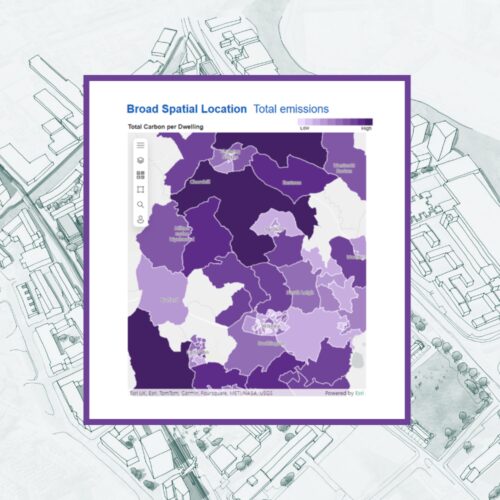
CC1 (Climate Change Policy 1) requires development plans to take a proactive approach to climate mitigation and the transition to net zero, in accordance with the Climate Change Act 2008.
Plans should use spatial strategies and allocations to contribute to “radical reductions” in greenhouse gas emissions. The policy expressly recognises that authorities can assess baseline carbon emissions and the future emissions associated with different development options.
This provides a strong basis for using carbon evidence to inform where growth should happen. The location of a development significantly affects travel patterns, infrastructure requirements and emissions over a development’s lifetime. Climate evidence should therefore shape the spatial strategy and site selection process, not sit solely within a standalone climate policy.
Oh – have we mentioned that our Net-zero Spatial Planning Tool can help you with exactly that?
What does the NPPF mean for clean energy and climate resilience?

The NPPF remains supportive of renewable and low-carbon energy, electricity networks, storage, heat networks and the recovery of surplus heat, including from data centres. Plans are expected to consider grid capacity and positively identify renewable energy and infrastructure opportunities.
Adaptation is also more prominent. CC1 and CC3 address overheating, drought, flooding, water supply, coastal change and wildfire risk. The final CC3 adds substantial weight for proposals that improve the resilience of existing buildings and public spaces to anticipated climate impacts.
So, what should local authorities do now the 2026 NPPF is published?

In our opinion, authorities should:
- Review emerging policies against the final PM13, rather than the consultation draft.
- Retain ambition where it is justified, including energy use, space heat demand and embodied carbon requirements.
- Strengthen the evidence base, particularly on carbon need, technical feasibility, costs, viability and deliverability.
- Explain why each metric is appropriate and how compliance will be assessed.
- Integrate carbon into spatial strategy, site selection and infrastructure planning.
- Address adaptation alongside mitigation, including future overheating and climate risk.
The final NPPF has not removed every obstacle to creating climate-leading developments. Its preference for TER remains problematic, and the interpretation of PM13 and other policies will continue to evolve.
But the feared removal of local authorities having the ability to set local energy standards has not materialised.
Our advice is straightforward: do not reduce your ambition. Strengthen the evidence behind it.
(Obvious legal line that we have to write anyway: this article reflects Bioregional’s initial interpretation and does not constitute legal advice.)
Watch our NPPF reaction webinar
Say hello
Need help unpicking what the new NPPF means for you? You've found your people.
We've helped over 20 local plans stand up as sound, with robust climate change and net-zero evidence, alongside extensive submission and examination support.
- Ambitious, like you
- Comfortable in complexity
- We make it easy


NPPF 2026: frequently asked questions ↓